A Decision-Making Tool for the B2B Sharing Economy
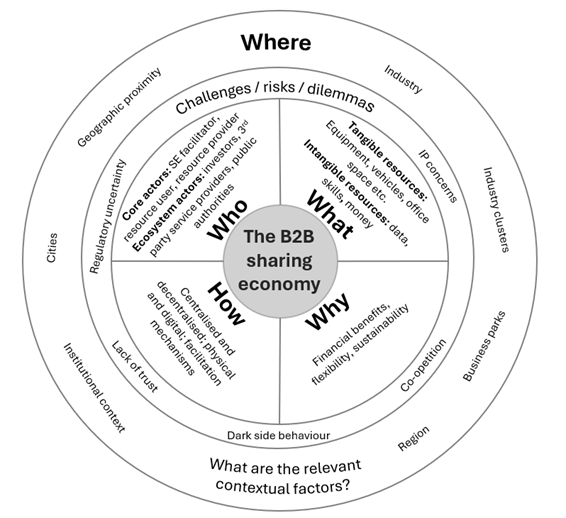
The B2B sharing economy is often discussed in broad terms, platforms, access, and ecosystems, but for managers, the real challenge is much more practical:
How do we actually decide what to share, with whom, and under what conditions?
To address this, I developed a decision-making framework that unpacks the B2B sharing economy into five interrelated dimensions: Who, What, How, Why, and Where.
At its core, the model recognises a simple but often overlooked reality:
These dimensions do not operate independently; they shape and constrain one another.
Breaking Down the Model
- Who — The Actors Involved
The B2B sharing economy is inherently multi-actor.
This includes:
Platform or facilitator
Resource provider (asset owner)
Resource user (customer)
Third parties (e.g., regulators, partners, intermediaries)
The specific configuration of actors matters.
For instance, sharing within a closed ecosystem of trusted partners is fundamentally different from sharing via an open, platform-mediated marketplace.
- What — The Resources Being Shared
Not all resources are equal.
The model distinguishes between:
Tangible resources: equipment, machinery, warehouse space, office space
Intangible resources: data, capabilities, skills
The nature of the resource has direct implications:
High-value, sensitive assets (e.g., medical equipment) require tighter control
Standardised, low-risk assets (e.g., storage space) are easier to share at scale
- How — The Governance and Mechanisms
This dimension captures how sharing is organised and managed.
It includes:
Platform-mediated vs direct sharing
Pricing models (pay-per-use, subscription, revenue sharing)
Contracts, standards, and coordination mechanisms
Critically, “how” is not chosen in isolation—it is shaped by both who is involved and what is being shared.
- Why — The Strategic Motivation
Firms engage in the B2B sharing economy for different reasons:
Cost reduction and efficiency
Access to otherwise unavailable resources
Flexibility and scalability
Sustainability and improved utilisation
The “why” influences decision-making across all other dimensions.
For example, sharing for sustainability goals may prioritise long-term partnerships, while sharing for cost efficiency may favour open marketplaces.
- Where — The Context
Finally, all of this is embedded within a broader context:
Industry characteristics
Geographic location and proximity
Institutional environment and regulation
Cluster dynamics and ecosystem maturity
What works in a Norwegian industrial cluster may not translate directly to a fragmented emerging market.
The Key Insight:
The real contribution of the model is not just in identifying these dimensions, but in showing how they interact.
For example:
What you share (e.g., sensitive vs standardised assets) influences
→ How you share (tight governance vs open platform)
→ and Who is involved (trusted partners vs broad market)
Where you operate (e.g., high vs low institutional trust) shapes
→ the governance mechanisms you need
→ and the feasibility of platform-based models
Why you engage (e.g., efficiency vs innovation) affects
→ partner selection (who)
→ and the structure of agreements (how)
In other words, you cannot change one dimension without affecting the others.
From Concept to Tool
Rather than offering a one-size-fits-all model, this framework is designed as a decision-support tool.
Managers can use it to:
Map existing or potential sharing arrangements
Identify misalignments (e.g., risky assets with weak governance)
Compare alternative configurations
Make more informed strategic decisions about participation

