What managers need to know about the B2B sharing economy
For decades, managers have been taught a simple rule: if a resource is critical, own it. Ownership meant control, reliability, and competitive advantage. But that logic is quietly being challenged.
Across industries, firms are beginning to access rather than own. Idle warehouse space is shared across companies. Specialised machinery is rented on demand. Even highly sensitive assets, like medical equipment or manufacturing capacity, are being made available through digital platforms connecting businesses that would never have interacted before.
This is often framed as the “B2B sharing economy.” But the term can be misleading. This is not about generosity or collaboration for its own sake. It is about efficiency, flexibility, and, increasingly, survival in uncertain markets.
For managers, this shift raises a set of uncomfortable but necessary questions.
If your competitive advantage depends on owning assets, what happens when access becomes cheaper and more flexible than ownership?
If your expensive resources sit idle even part of the time, are they really strategic assets, or just underutilised costs?
And if other firms can access what you own, what exactly are you competing on?
The implications go beyond cost savings. The B2B sharing economy is fundamentally about reorganising how value is created and captured. Instead of bilateral buyer–seller relationships, managers must navigate triadic (and often more complex) arrangements involving platforms, providers, and users. Control becomes distributed. Trust becomes central. Governance becomes more complex.
This also introduces new risks. Sharing assets means sharing dependencies. It can expose firms to operational uncertainty, coordination challenges, and even reputational risks. Not everything should be shared, and knowing what not to share may be just as important as knowing what to share.
Yet, the opportunities are equally significant. Firms can unlock new revenue streams from idle capacity, lower barriers to entry for innovation, and access resources that would otherwise be prohibitively expensive. For startups and smaller firms, this can be transformative. For established companies, it can be a way to become more agile without large capital investments.
Perhaps the most important shift, however, is conceptual. The question is no longer “What do we own?” but “What can we access, and under what conditions?”
Managers who continue to think in terms of ownership alone risk missing this shift. Those who begin to think in terms of access, orchestration, and ecosystems may find entirely new ways to compete.
This is not a distant trend. It is already unfolding, quietly, unevenly, but decisively, across industries.
And it may well redefine how you run your business.
This phenomenon has been the focus of my PhD research over the past several years, where I have explored how businesses engage in and manage these emerging forms of resource sharing.
Mapping the Global B2B Sharing Economy: Who’s Sharing What—and Where
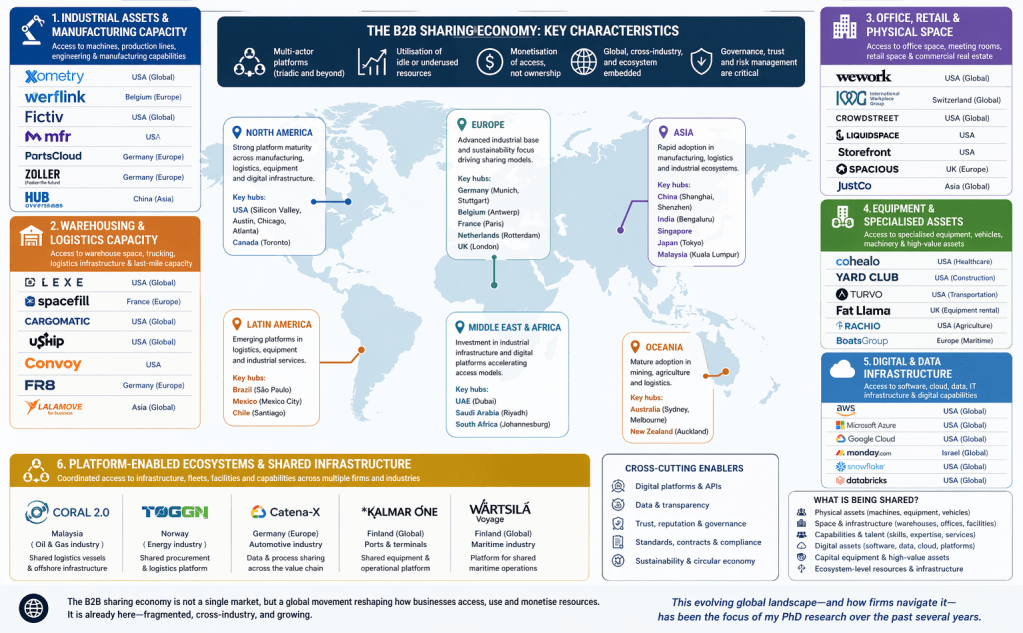
If the consumer sharing economy was made visible by platforms like Airbnb and Uber, the business-to-business (B2B) sharing economy is unfolding more quietly, across factories, warehouses, and supply chains.
But make no mistake: it is global, diverse, and already deeply embedded in how firms operate.
Rather than a single market, what we see is a patchwork of platforms and models, emerging across industries and regions—each unlocking access to different types of resources.
- Industrial assets and manufacturing capacity
In Europe, platforms like Werflink (Belgium) and Xometry (U.S./global) connect firms with underutilised CNC machines, production lines, and engineering capabilities.
In Germany and across Central Europe, similar models are emerging within advanced manufacturing clusters, allowing firms to access precision production without owning expensive machinery.
Meanwhile, in Asia, China’s manufacturing networks are increasingly platform-mediated, where excess capacity is dynamically allocated across firms.
What’s being shared: machines, production capacity, engineering capabilities
Where: Belgium, Germany, the U.S., and China
- Warehousing and logistics capacity
In the U.S., Flexe enables companies to access unused warehouse space across a distributed network, effectively turning logistics infrastructure into an on-demand service.
In France, Spacefill connects firms with available storage capacity, while in the Nordics and broader Europe, similar models are emerging around logistics hubs and last-mile delivery networks.
In parallel, freight platforms like Cargomatic (U.S.) match unused trucking capacity with demand in real time.
What’s being shared: warehouse space, trucking capacity, logistics infrastructure
Where: U.S., France, broader Europe
- Office, retail, and physical space
The rise of WeWork (global, founded in the U.S.) made shared office space mainstream, but the model has evolved far beyond startups.
Retail spaces, commercial real estate, and even industrial sites are increasingly shared across firms, particularly in dense urban hubs like London, New York, and Singapore.
In emerging markets, flexible space models are enabling small firms to access premium locations without long-term commitments.
What’s being shared: office space, retail space, commercial real estate
Where: Global (U.S., UK, Singapore, major cities worldwide)
- Equipment and specialised assets
In healthcare, platforms like Cohealo (U.S.) enable hospitals to share high-value equipment such as MRI machines across networks, reducing idle time and capital expenditure.
In construction, earlier examples like Yard Club (U.S.) demonstrated how heavy equipment, from excavators to cranes, can be shared across firms rather than owned individually.
These models are now spreading into sectors like agriculture, energy, and maritime industries.
What’s being shared: medical equipment, construction machinery, etc. Where: expanding globally
A Decision-Making Tool for the B2B Sharing Economy
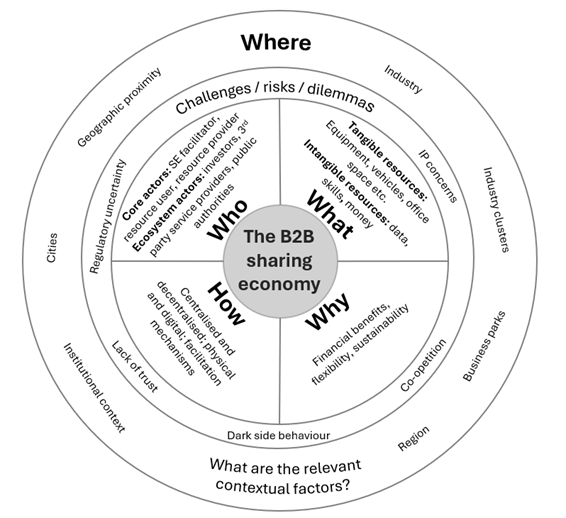
The B2B sharing economy is often discussed in broad terms, platforms, access, and ecosystems, but for managers, the real challenge is much more practical:
How do we actually decide what to share, with whom, and under what conditions?
To address this, I developed a decision-making framework that unpacks the B2B sharing economy into five interrelated dimensions: Who, What, How, Why, and Where.
At its core, the model recognises a simple but often overlooked reality:
These dimensions do not operate independently; they shape and constrain one another.
Breaking Down the Model
- Who — The Actors Involved
The B2B sharing economy is inherently multi-actor.
This includes:
Platform or facilitator
Resource provider (asset owner)
Resource user (customer)
Third parties (e.g., regulators, partners, intermediaries)
The specific configuration of actors matters.
For instance, sharing within a closed ecosystem of trusted partners is fundamentally different from sharing via an open, platform-mediated marketplace.
- What — The Resources Being Shared
Not all resources are equal.
The model distinguishes between:
Tangible resources: equipment, machinery, warehouse space, office space
Intangible resources: data, capabilities, skills
The nature of the resource has direct implications:
High-value, sensitive assets (e.g., medical equipment) require tighter control
Standardised, low-risk assets (e.g., storage space) are easier to share at scale
- How — The Governance and Mechanisms
This dimension captures how sharing is organised and managed.
It includes:
Platform-mediated vs direct sharing
Pricing models (pay-per-use, subscription, revenue sharing)
Contracts, standards, and coordination mechanisms
Critically, “how” is not chosen in isolation—it is shaped by both who is involved and what is being shared.
- Why — The Strategic Motivation
Firms engage in the B2B sharing economy for different reasons:
Cost reduction and efficiency
Access to otherwise unavailable resources
Flexibility and scalability
Sustainability and improved utilisation
The “why” influences decision-making across all other dimensions.
For example, sharing for sustainability goals may prioritise long-term partnerships, while sharing for cost efficiency may favour open marketplaces.
- Where — The Context
Finally, all of this is embedded within a broader context:
Industry characteristics
Geographic location and proximity
Institutional environment and regulation
Cluster dynamics and ecosystem maturity
What works in a Norwegian industrial cluster may not translate directly to a fragmented emerging market.
The Key Insight:
The real contribution of the model is not just in identifying these dimensions, but in showing how they interact.
For example:
What you share (e.g., sensitive vs standardised assets) influences
→ How you share (tight governance vs open platform)
→ and Who is involved (trusted partners vs broad market)
Where you operate (e.g., high vs low institutional trust) shapes
→ the governance mechanisms you need
→ and the feasibility of platform-based models
Why you engage (e.g., efficiency vs innovation) affects
→ partner selection (who)
→ and the structure of agreements (how)
In other words, you cannot change one dimension without affecting the others.
From Concept to Tool
Rather than offering a one-size-fits-all model, this framework is designed as a decision-support tool.
Managers can use it to:
Map existing or potential sharing arrangements
Identify misalignments (e.g., risky assets with weak governance)
Compare alternative configurations
Make more informed strategic decisions about participation

