Mapping the Global B2B Sharing Economy: Who’s Sharing What—and Where
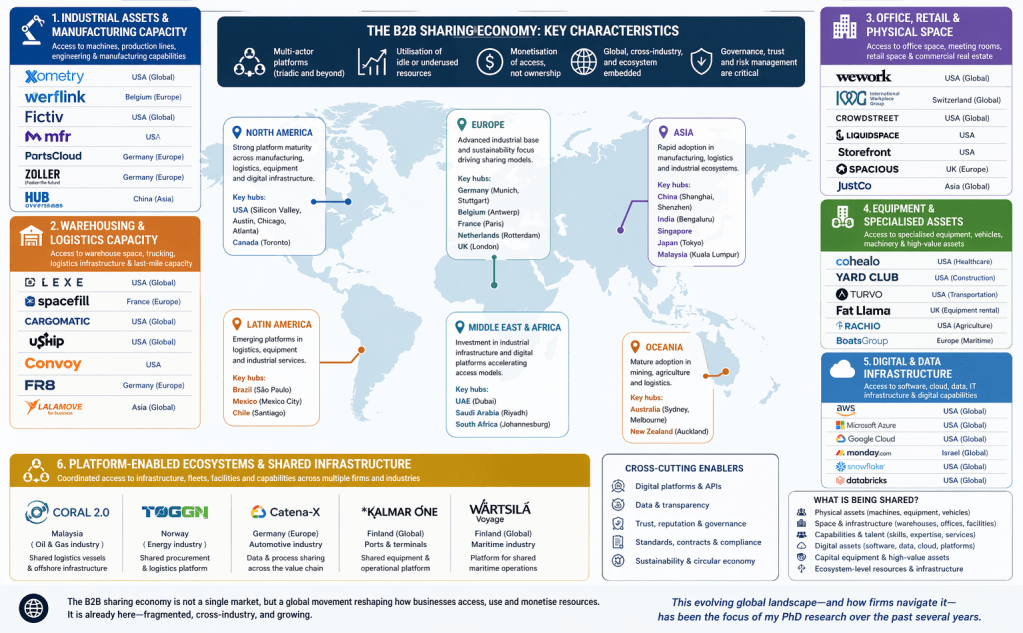
If the consumer sharing economy was made visible by platforms like Airbnb and Uber, the business-to-business (B2B) sharing economy is unfolding more quietly, across factories, warehouses, and supply chains.
But make no mistake: it is global, diverse, and already deeply embedded in how firms operate.
Rather than a single market, what we see is a patchwork of platforms and models, emerging across industries and regions—each unlocking access to different types of resources.
- Industrial assets and manufacturing capacity
In Europe, platforms like Werflink (Belgium) and Xometry (U.S./global) connect firms with underutilised CNC machines, production lines, and engineering capabilities.
In Germany and across Central Europe, similar models are emerging within advanced manufacturing clusters, allowing firms to access precision production without owning expensive machinery.
Meanwhile, in Asia, China’s manufacturing networks are increasingly platform-mediated, where excess capacity is dynamically allocated across firms.
What’s being shared: machines, production capacity, engineering capabilities
Where: Belgium, Germany, the U.S., and China
- Warehousing and logistics capacity
In the U.S., Flexe enables companies to access unused warehouse space across a distributed network, effectively turning logistics infrastructure into an on-demand service.
In France, Spacefill connects firms with available storage capacity, while in the Nordics and broader Europe, similar models are emerging around logistics hubs and last-mile delivery networks.
In parallel, freight platforms like Cargomatic (U.S.) match unused trucking capacity with demand in real time.
What’s being shared: warehouse space, trucking capacity, logistics infrastructure
Where: U.S., France, broader Europe
- Office, retail, and physical space
The rise of WeWork (global, founded in the U.S.) made shared office space mainstream, but the model has evolved far beyond startups.
Retail spaces, commercial real estate, and even industrial sites are increasingly shared across firms, particularly in dense urban hubs like London, New York, and Singapore.
In emerging markets, flexible space models are enabling small firms to access premium locations without long-term commitments.
What’s being shared: office space, retail space, commercial real estate
Where: Global (U.S., UK, Singapore, major cities worldwide)
- Equipment and specialised assets
In healthcare, platforms like Cohealo (U.S.) enable hospitals to share high-value equipment such as MRI machines across networks, reducing idle time and capital expenditure.
In construction, earlier examples like Yard Club (U.S.) demonstrated how heavy equipment, from excavators to cranes, can be shared across firms rather than owned individually.
These models are now spreading into sectors like agriculture, energy, and maritime industries.
What’s being shared: medical equipment, construction machinery, etc. Where: expanding globally
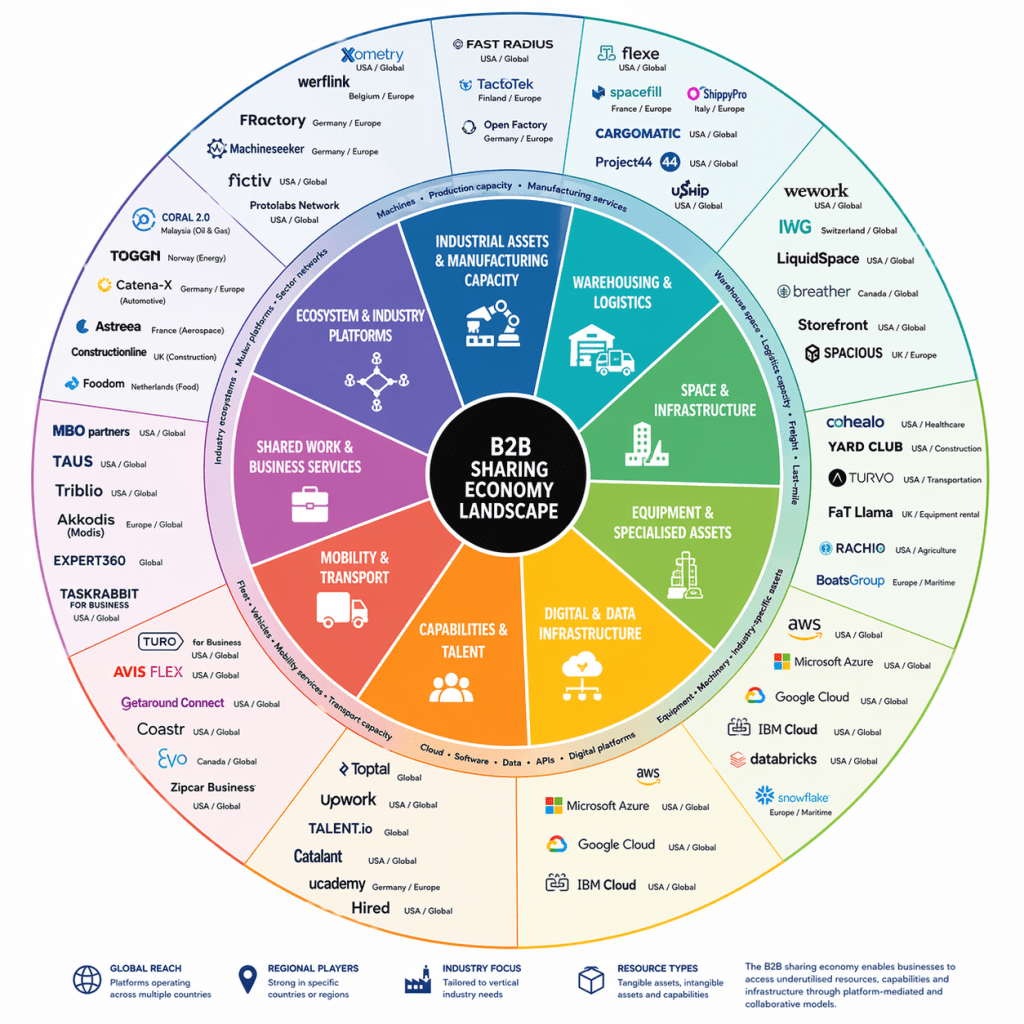
Inspired by Jeremiah Owyang’s Collaborative Economy Honeycomb (2016), I set out to map the emerging B2B sharing economy. The image below is a work in progress.
 KELVIN IVANKOVIC